
Suzuki Every Passenger Mini Trucks
The Suzuki Every Japanese mini truck combines true 4×4 off-road capability with seating for four and a spacious enclosed cargo area. Its design ensures both passengers and gear are protected from the elements, making it a dependable choice for challenging terrain.
Jump To Section
Introduction
The Suzuki Every is a full 4-passenger off-road alternative to UTVs or golf carts—except that it’s better. It features two separate front seats plus a rear bench seat, providing more than enough space for four adults to travel off-road comfortably. While these mini trucks are capable of going off-road into the mud alongside other off-road UTVs, their more typical use is transporting people and equipment around large private properties.
For instance, many colleges, hospitals, or similar large-campus operations use golf carts or work UTVs to move people and gear off-road around their properties. However, neither of these are well-suited for the task. Golf carts lack proper weather protection and comfort, while typical work UTVs are loud, uncomfortable, and have limited cargo capacity. In situations like these, the Suzuki Every (and the Daihatsu Cargo) excel, offering a practical and effective solution.
Despite the January 2026 refresh of its sister Suzuki Carry and Super Carry models, there is no indication as to when a similar refresh could be coming to these Suzuki Every kei trucks. The current version of this DA17V is becoming quite dated, so it seems likely that a replacement will be introduced in the near future.

Interior
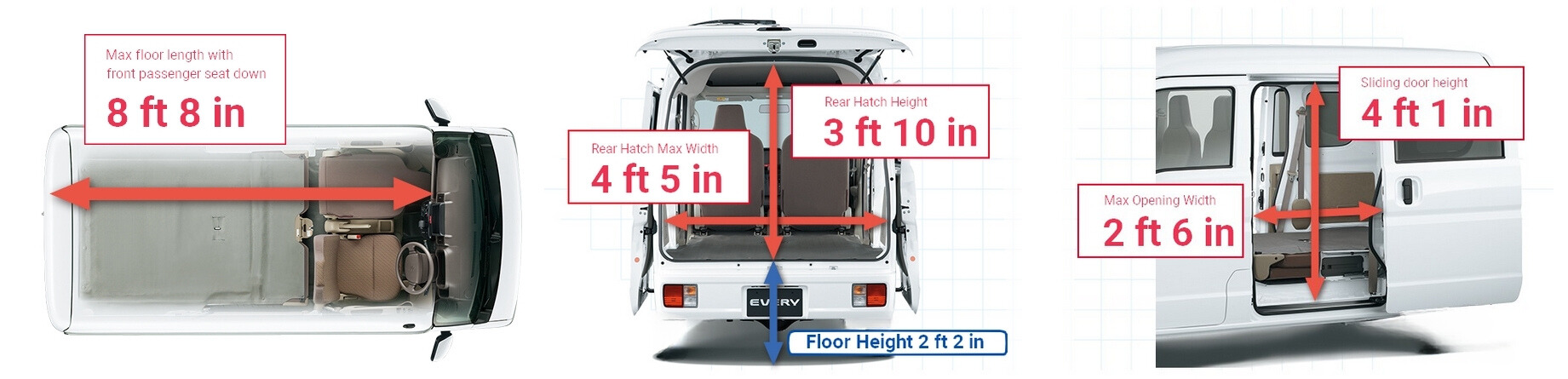
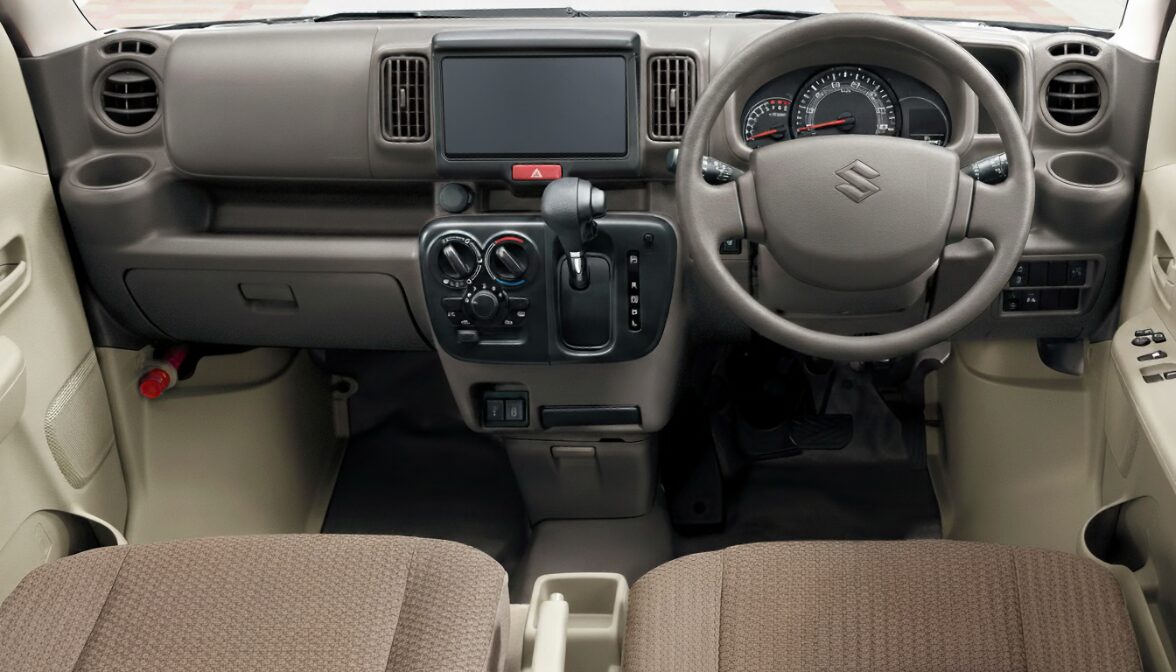
Let’s take a closer look at the most modern DA17V Suzuki Every, starting with the interior. Japanese mini trucks are, as the name suggests, ‘mini,’ but their smart packaging ensures a surprising amount of interior space despite compact exterior dimensions. This spaciousness is largely due to the almost ‘brick-like’ rectangular shape of the Every, as well as the efficient design of the engine and transmission, which maximizes room for both passengers and gear. With this in mind, let’s explore the interior of this latest model, which debuted in 2015.
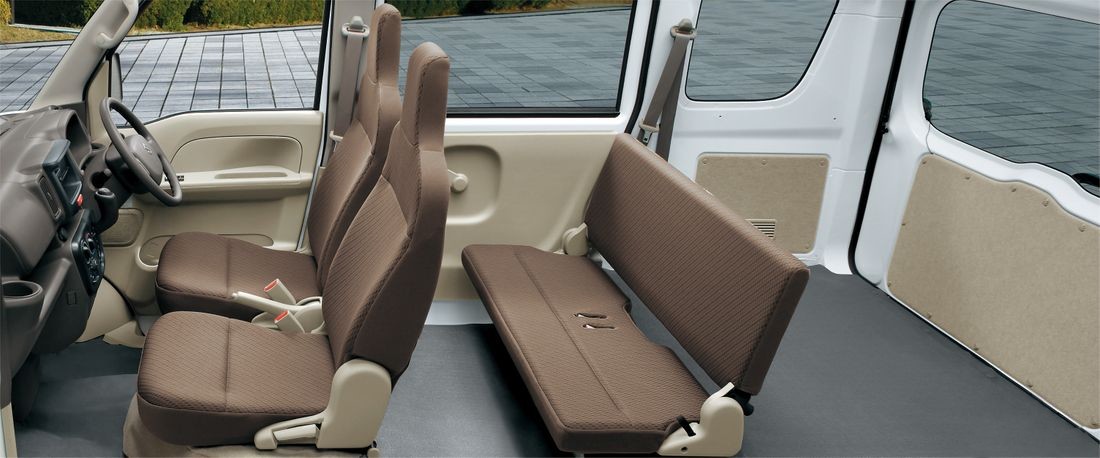
The first thing you’ll notice is that these are regular, comfortable seats—not the bucket seats commonly found in some UTVs. They are designed for comfort and have a practical shape that makes getting in and out easy. Additionally, the seats offer significant fore and aft adjustability and can recline flat, ensuring that even in a compact off-road Japanese mini truck like this, you’ll have no trouble finding a comfortable seating position.
Then there are the rear seats. Yes, it’s a bench seat, much like the one in its rival, the Hijet Cargo, but it’s perfectly suited for the short journeys typically required when using this mini truck off-road on a college or hospital campus, or even at a large manufacturing facility.
To make the interior an even more comfortable and practical space, it includes:
- UV-cutting window glass all around.
- Adjustable AC and heat for climate control.
- Power steering for ease of maneuvering.
- Power windows for extra convenience.
- Interior lighting to enhance visibility.
- Power door locks with remote unlocking and locking functionality.
- Multiple storage options throughout the cabin, not limited to the glove compartment.
- A cup holder to securely hold your water bottle or coffee cup during your journey.
Body Colors
The interior of the cab offers a comfortable and versatile space, with configurations that work equally well whether you’re transporting passengers or cargo. But what about the exterior? Suzuki provides a range of understated, stylish colors that lend the Every van a polished and professional appearance. Here are the latest exterior color options as of January 2026.


Engine And Transmission
The Suzuki Every is a dependable workhorse, ideal for transporting people and equipment in settings such as college campuses, hospital grounds, or similar off-road environments. Its performance, however, comes down to the engine and transmission. Like the Daihatsu Hijet Cargo, the Suzuki Every operates within the same stringent regulations that apply to all Japanese mini trucks, which limit the scope for engineering flexibility. With that in mind, let’s delve into the details, starting with the engine.
Engine
The engine in the Suzuki Every is the same R06A-type 3-cylinder water-cooled engine found in the Super Carry and Carry models. It features electronic fuel injection and variable valve timing, delivering maximum power at 5,700 rpm, with peak torque arriving at a lower 3,500 rpm. Notably, while both the R06A in the Every and the KF engine in the Daihatsu Hijet Cargo reach their power peaks at 5,700 rpm, the Suzuki engine hits its maximum torque 500 rpm earlier than Daihatsu’s KF engine. Although the torque output isn’t enormous, having peak torque arrive earlier gives the Suzuki an advantage, especially in low-end pulling power. Both engines, however, provide sufficient pulling power to keep you moving and hauling across challenging terrain.
The R06A engines in the Suzuki Every are a marked improvement over their predecessor K6A engines, boasting 10% less internal friction. These engines were the first in the mini truck class to feature variable valve timing (VVT) and were also the lightest in their class when first introduced. That said, with the DA16T platform now nearly a decade old, the R06A engine is starting to show its age compared to newer technology, such as the Hijet’s fuel-saving start-stop system. It remains to be seen how Suzuki will respond when the DA17V generation Every is eventually replaced.
The R06A engine also adheres to high NVH (Noise, Vibration, Harshness) standards, which are quite impressive for an off-road UTV. While you might not consciously notice it, the smooth and quiet operation reduces fatigue when driving off-road all day, making it a more pleasant experience overall.
In terms of maintenance, these engines are straightforward to work on. They run on regular gasoline, and common maintenance tasks like replacing air or oil filters are simple, with parts readily available. If you experience harsh winters, the use of antifreeze is essential, just as with any other UTV. Overall, these engines are designed for easy maintenance, allowing you to handle routine upkeep without difficulty.
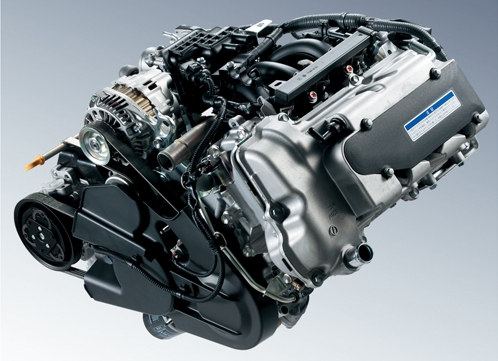
As for the engine placement, it is mounted low beneath the seats, a design that provides the Suzuki Every with an excellent low center of gravity—ideal for a UTV. The seats are easy to remove, giving direct access to the engine for tasks like oil changes or other maintenance work.
Although you might not get a clear view of the engine when accessing it under the seats, here it is—a compact and efficient design that reflects engineering precision on par with a Swiss watch.
Transmission
While Daihatsu offers two transmission options—CVT or manual—Suzuki offers three: manual, CVT, and regular 4-speed automatic (on the PA-badged model only). Let’s start with the manual.
Manual
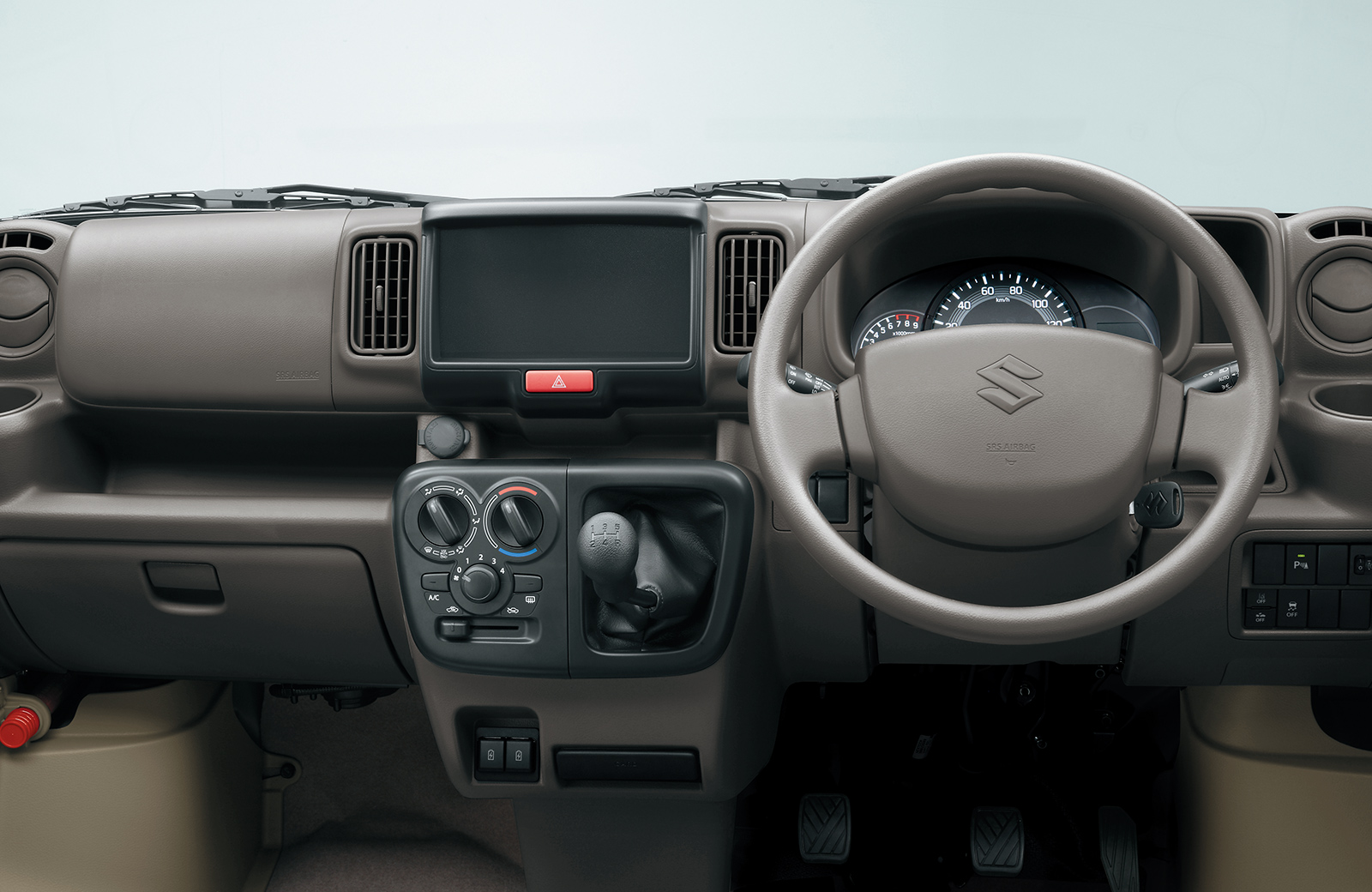
Every mini trucks equipped with manual transmissions features a 5-speed gearbox, similar to the models offered by Daihatsu. As with Daihatsu, the transmission shifter is mounted on the dashboard. While this setup might take some time to get used to, it offers a key advantage—there’s no transmission tunnel. This design provides more space for legs and feet and allows you to slide across to the other side with ease since there’s nothing obstructing the way.
Automatic
The DA17V Every iteration comes with a traditional 4-speed automatic transmission, but as of February 27, 2024, this is now only available for the base Every PA models. For all other grades, this transmission has been replaced with a CVT one, bringing it in line with the latest Daihatsu Hijet Cargo van mini trucks.
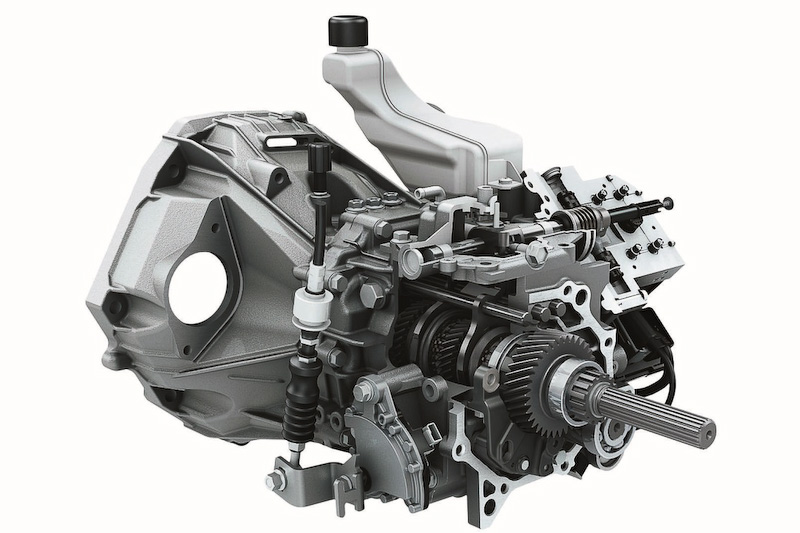
5AGS automatic
The 5AGS transmission, short for ‘Auto Gear Shift,’ is a unique system designed to combine the advantages of both manual and automatic transmissions. The ‘5’ refers to its five gears, while ‘AGS’ highlights its ability to shift automatically. Essentially, it is a 5-speed manual transmission equipped with an automated shifting mechanism, offering improved fuel economy over a traditional automatic while maintaining the flexibility of manual control.
In practical terms, the 5AGS system allows drivers to switch between full automatic and manual modes, depending on their requirements. This versatility makes it well-suited for a range of off-road driving scenarios. While the engineering behind the system is complex, it is designed to deliver both efficiency and convenience in operation. See the details below for a closer look at its design and functionality.
4WD System
It’s important to reiterate that all Japanese mini trucks shown for sale at Mini Truck Depot are for off-road use only which, of course, means that all those kei trucks for sale you can see here have 4WD.
On the older-style Every setups (and on 4WD models with 5MT or 4AT), you get a simple button that lets you select 2WD or 4WD. Now, most of the time it’s fine to leave it in 4WD particularly if you’re moving between a mixture of surfaces all day. Still, there are plenty of situations where switching back to 2WD makes sense to save fuel—especially when you’re just rolling along on a packed, dry dirt track and you don’t need any extra grip.
Where the story gets more interesting is with the newer 2024 spec. Suzuki has now moved beyond the “just a button” setup on 4WD CVT models, and honestly, it’s about time. Those models use an electronic 4WD system with three modes: 2WD / 4WD AUTO / 4WD LOCK. So instead of you having to babysit the switch every time the ground changes, 4WD AUTO can handle that moment when traction drops off and you want the rear to help out. Then 4WD LOCK is there when things get properly slippery and you just want to keep it on 4WD all the time. All in all, basically the same set up as the modern Daihatsu set up, with Suzuki once more playing catch-up with the market leader. Taking it a step further, Suzuki also added something called Mud Escape Assist on CVT models, which helps when one wheel starts spinning due to a difference in grip. It sounds very exciting, but its hard to see what advantage that gives you over the rear locking diff that has been available on the Hijet Cargo CVT models for considerably longer.
If you’re comparing it to the Hijet Cargo, this puts the Every in a much better place than it was just a few years ago Daihatsu made a strong move with smarter traction control on later Hijet variants, and Suzuki’s newer 4WD AUTO/LOCK / Mud Escape Assist setup feels like a real response. But, once again, its Daihatsu that’s out in front setting the pace with Suzuki struggling to even keep up.
Buying A Suzuki Every Van Mini Truck
Daihatsu Hijet Cargos seem to be the preferred passenger van mini truck option in the US, which is why it will often be these mini trucks you see for sale here if we have any. If you are particularly interested in getting a Suzuki Every, please contact us here if you don’t see any in our mini truck sales area.
